Massage & Body Therapy
Deep Tissue Massage
Duration: 60 minutes
Deep tissue is the cornerstone of our positioning as Sharjah’s pain-relief and recovery specialists. Where a relaxation massage glides over the surface, deep tissue works slowly and deliberately into the deeper layers of muscle and connective tissue — the places where months of desk posture, driving and physical work quietly accumulate.
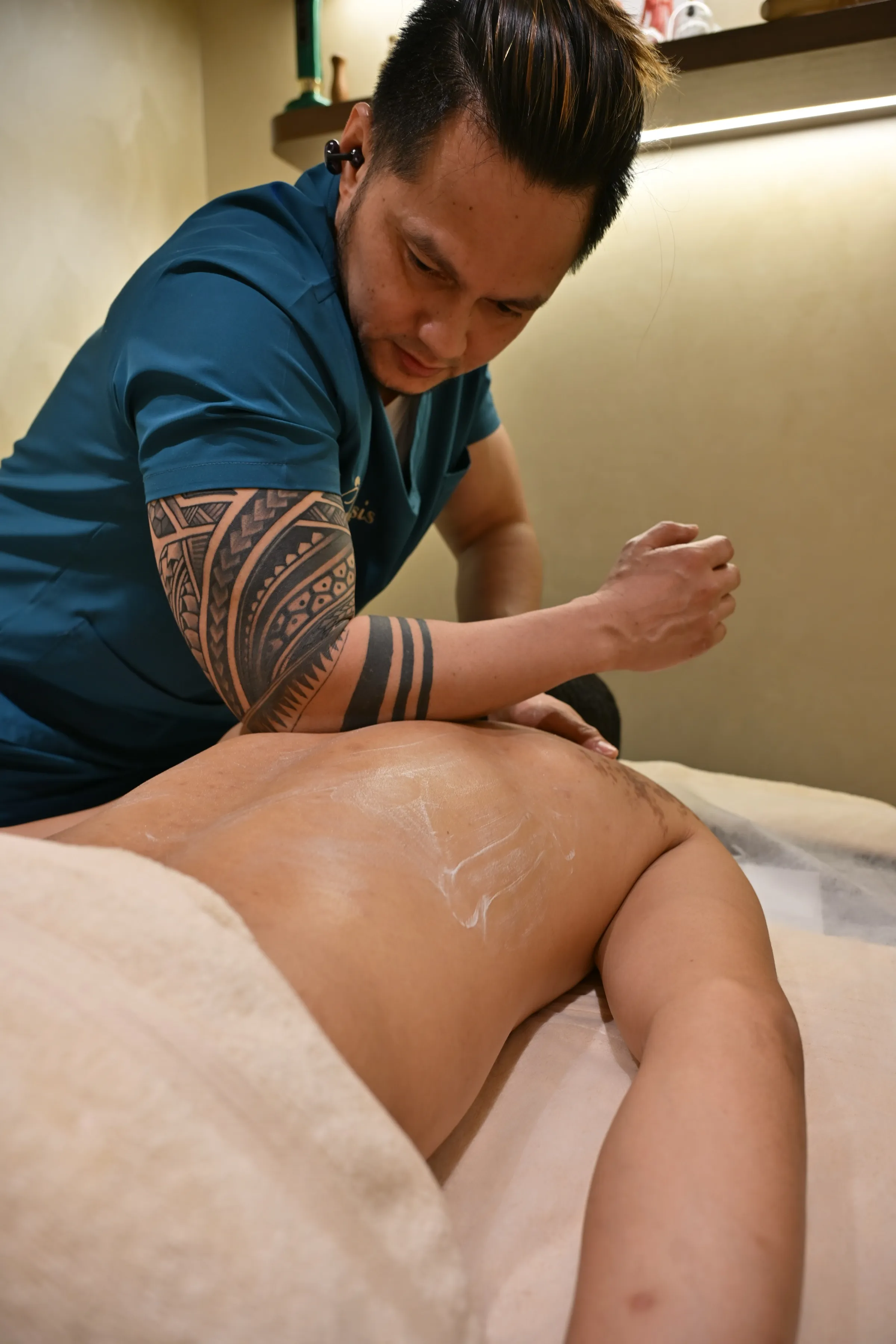
Your therapist uses forearms, elbows and sustained pressure to release stubborn knots and adhesions, focusing on the areas you identify at the start of the session: typically the lower back, shoulders and neck. The pace is unhurried by design; deep work done slowly is effective, deep work done fast is merely painful. Expect firm pressure that stays within your tolerance — communication is part of the treatment.
Mild soreness for a day or two afterwards is normal and a sign the tissue is responding. Drink water, take it easy, and let the release settle in.
Who it’s for
- Desk workers with chronic neck, shoulder or lower-back tightness
- Drivers and delivery professionals with accumulated postural strain
- Manual and site workers whose bodies carry the week’s load
- Gym-goers with persistent, specific muscle knots
- Anyone for whom relaxation massage feels too light to make a difference
Recommended frequency
Every two to four weeks for maintenance; weekly for a short period when working through a specific area of chronic tension.
Benefits
- May help release chronic muscle knots and adhesions
- Commonly used for persistent lower-back, neck and shoulder tension
- Supports improved range of motion and postural comfort
- May help reduce muscle pain after repetitive strain
- Supports recovery between demanding training or work weeks
- Many guests report deeper, more restful sleep afterwards
Take care if…
- — You take blood-thinning medication or have a bleeding or clotting disorder — consult your doctor first
- — Deep vein thrombosis (DVT), varicose veins in the treatment area, or recent surgery
- — Osteoporosis or fragile bone conditions — a gentler therapy is safer
- — Fever, acute inflammation or infection — please reschedule until you are well
Our treatments support wellbeing and are not a substitute for medical care. Please tell your therapist about any medical conditions or pregnancy before your session.
FAQs
Common questions
Will it hurt?
You should feel strong, purposeful pressure — sometimes on the edge of intensity — but never sharp pain. Your therapist checks in throughout and adjusts instantly.
Why am I sore the next day?
Deep work creates a mild, exercise-like soreness for 24–48 hours as the tissue recovers. Hydration and light movement help it pass quickly.
Deep tissue or sports massage — which do I need?
Choose deep tissue for chronic, posture-related tension; choose sports massage if your discomfort is tied to training, a specific activity or event preparation.
Can I add cupping or hot stones?
Yes — at our men’s branches, cupping, hot stone, fire treatment and acupuncture can all be added to a deep tissue session. Mention it when booking.
Booking
Book this treatment
Pairs beautifully with
From the Journal
Which massage should you book?
Choose by what you want to leave with, not by what sounds impressive. Book deep tissue for a specific, stubborn ache you can point to; full-body relaxation when you are worn down rather than injured; hot stone when cold, tight muscles need warming before they will let go; sports massage around training; and reflexology when you would rather stay clothed and still feel the day lift. If you genuinely cannot decide, book sixty minutes of deep tissue and tell the therapist where it hurts — they adjust pressure as they go.
7 min read
Your first massage: what actually happens
A first massage follows the same order every time. You arrive about ten minutes early and answer a few short questions about injuries, pain and any area you would rather was left alone; the therapist then leaves the room while you undress to whatever level you are comfortable with and lie under a towel or sheet. You stay covered for the entire session — only the area being worked on is uncovered, and it is covered again before the therapist moves on. Most people keep their underwear on, nobody comments on anyone’s body, and you are never undressed in front of anyone. You do not have to talk, and asking for lighter or firmer pressure at any point is expected rather than rude.
6 min read
How a home massage visit actually works
A home massage visit brings the treatment room to you: the therapist arrives with a folding table, fresh linens, towels and oils, and all you provide is a room with enough clear floor to walk right around the table, plus a bathroom to wash in afterwards. Allow roughly twenty to thirty minutes on top of the treatment time for setting up and packing down, so a sixty-minute massage occupies closer to an hour and a half of your evening. Family being home is not a problem — one room with a door that closes is enough. We visit homes in Sharjah, Ajman and Dubai, for both men and women, always with a same-gender therapist. In an apartment building, send a pinned location with the floor, the flat number and where to park, because that is what keeps a visit on time.
7 min read
A men’s guide to the spa in Sharjah
Most men book their first treatment because something hurts — a lower back set by driving, shoulders set by a desk, or legs that stopped recovering between training sessions. Start with sixty minutes of deep tissue and say where the problem is in the first minute; if undressing is the part you are unsure about, reflexology keeps you fully clothed and still does real work. Our two men’s branches in Sharjah, Rahmania and Muweilah, are men-only buildings with male therapists throughout, so there is nothing to request and nothing to negotiate at the door. Both open daily from 10:30 until midnight, except on Fridays, when the men’s branches open at 13:30. Most men who keep coming back do so for recovery rather than for luxury, and once a month is where the majority settle.
7 min read
Spa etiquette in the UAE: the questions nobody asks out loud
Arrive about fifteen minutes early, wear whatever you arrived in because you change at the spa, and undress only to the level you are comfortable with — you stay covered by a towel or sheet throughout, and only the area being worked on is uncovered. Tipping is common across the UAE service sector and it is appreciated, but it is never expected or required, and nobody is treated any differently for not tipping. If the pressure is too firm or too light, say so the moment you notice; adjusting it is part of the therapist’s job and not a complaint. Phones go on silent, conversation is entirely optional, and there is no need to shower beforehand, though you are welcome to. If you are running late or need to cancel, a phone call is all that is required — the earlier the better, and nobody will make it awkward.
6 min read
After your massage: the next 24 hours
Expect mild, dull soreness for a day or two after deep work, spread across the area that was worked rather than concentrated in one sharp point. Drink water normally, keep moving gently, and move the heavy training session you had planned for that evening. Warmth suits general tightness; a brief cool pack suits one spot that feels hot and angry. Massage does not flush toxins out of the body — that story is not true, and the honest reason to drink water is simply that most people arrive slightly short of it. See a doctor rather than book again if the pain is sharp rather than achy, is worse after three days, or comes with numbness, weakness, swelling in one leg, or a fever.
6 min read