Benefits · Poor circulation
Massage and circulation: does it really improve blood flow?
By the Sole Oasis therapy team
The short answer
Yes — locally and for a while. Strokes toward the heart assist venous return and measurably raise blood flow in the massaged tissue during and after a session, much like the muscle pump when you walk. Long-term changes to whole-body circulation are not established, so think of massage as regular help for the system, not a treatment for a vascular condition.
Circulation is the quiet logistics network of the body — delivering oxygen and nutrients, carrying away waste, regulating warmth. When it runs sluggishly, you feel it as cold feet, heavy legs and slow recovery. Massage offers a simple, mechanical way to help it along.
What healthy circulation actually does
Every cell in the body depends on blood flow for oxygen and nutrients, and on the return journey — through the veins and the lymphatic system — to clear metabolic waste. Muscles recover faster, skin looks healthier and energy feels steadier when this exchange runs well.
The return journey is the hard part. Veins in the legs work against gravity and rely heavily on muscle movement to pump blood back towards the heart. Hours of sitting — at a desk, in traffic, on a flight — take that pump out of action, which is why legs and feet are the first places sluggish circulation makes itself felt.
How massage supports blood flow
Massage works mechanically: gliding strokes applied towards the heart compress soft tissue and assist venous return, much as muscle contractions do during a walk. Local blood flow in massaged tissue measurably increases during and after treatment, bringing warmth and a visible flush to the skin.
It is worth being honest about the limits of the evidence: research confirms these local, short-term effects, while long-term changes to whole-body circulation are less established. Think of massage as regular assistance for the system rather than a permanent upgrade to it — the benefit comes from repetition, the same way it does with exercise.
Cold feet, air conditioning and desk-bound days
Life in the UAE adds its own twist: months of moving between hot streets and heavily air-conditioned interiors, long commutes and desk-based work all encourage blood flow to pool in the lower body and retreat from the extremities. Persistently cold feet in a cooled office are a familiar complaint.
Foot-focused treatments answer this directly. Reflexology combines firm, systematic pressure across the feet with the circulatory benefit of hands-on work exactly where flow is slowest, while hot stone massage adds gentle heat that encourages blood vessels near the skin to dilate.
Choosing a treatment — and a sensible word of caution
For general circulatory support, reflexology and hot stone massage are the natural starting points; lymphatic drainage focuses on the fluid-return side of the network, and cupping therapy — an add-on to a massage — draws blood flow strongly to specific areas. Our therapists will match the treatment to how your body actually feels on the day.
One important note: if you have a diagnosed circulatory condition — deep vein thrombosis, severe varicose veins, uncontrolled blood pressure — or you take blood-thinning medication, check with your doctor before booking. Massage supports healthy circulation; it is not a treatment for vascular disease. For everyone else, an evening session is easy to fit in — we are open every day until midnight.
Leg and foot massage for circulation
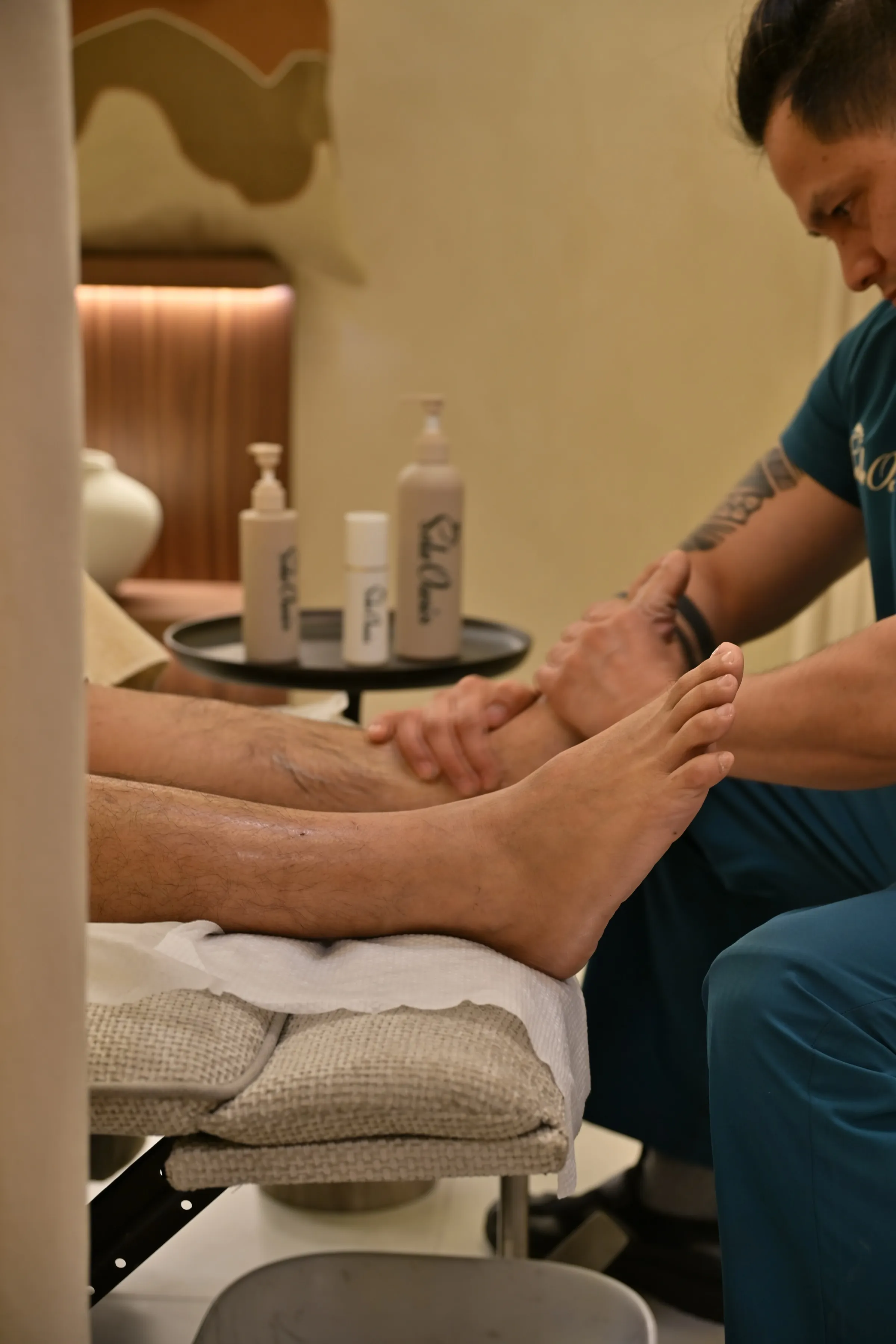
The calves are sometimes called the second heart: every step squeezes the deep veins of the lower leg and pushes blood back up against gravity. Sit for eight hours and that pump idles, which is why feet go cold and ankles feel heavy by evening. A foot and lower-leg massage does by hand what walking does by muscle — firm strokes from the toes toward the knee empty the veins, and the warmth and flush you see afterwards is the local blood flow responding.
A 30-minute reflexology session is the most direct version: systematic thumb pressure across the whole sole, the arches and the heels, finishing with the calves. It suits desk workers, anyone who stands all day, and long-haul flyers whose feet swell on the plane. It also suits people who would rather stay clothed and have only their feet and legs worked.
How often, and how long does the effect last?
Hours, not weeks. The rise in local blood flow is measurable during the session and for a while afterwards, then the system settles back to its baseline — the same way a walk warms you up without permanently changing your circulation. That is not a weakness of massage; it is how circulation works. The useful comparison is exercise: one session feels good, a routine keeps the benefit present.
For desk-bound weeks, a weekly or fortnightly foot or leg session is a sensible rhythm. Between visits, the cheapest help is the one the body is built for: stand up every half hour, take the stairs, and walk after dinner. Drink water through the air-conditioned day — dehydration thickens the blood and slows everything down.
Foot massage for circulation in Sharjah: what to book
Foot massage and reflexology in Sharjah is booked as a 30- or 60-minute session at all three branches, from AED 75, and as a 60- or 90-minute home visit across Sharjah, Ajman and Dubai. For whole-body warmth, the 60-minute hot stone massage is the natural second choice; lymphatic drainage (45 minutes at the branches) works the fluid-return side instead — our lymphatic health guide explains the difference. Cupping draws blood strongly to one area and is booked as an add-on to a massage. Massage starts from AED 80, and every branch is open daily until midnight.